Lavender oil: varieties, origin and use at a glance
Lavender is the best-selling essential oil of all – and also the one where something other than expected is most often in the bottle. This overview sorts out the varieties, the origin and the use.
Three lavenders that are easily confused
| Type | Botanical | Scent | Note |
|---|---|---|---|
| True lavender | Lavandula angustifolia | soft, floral, lightly herbal | grows at altitude, low yield |
| Lavandin | Lavandula x intermedia | fresher, sharper, camphorous | a cross, far higher yield |
| Spike lavender | Lavandula latifolia | strong, eucalyptus-like | highest camphor content |
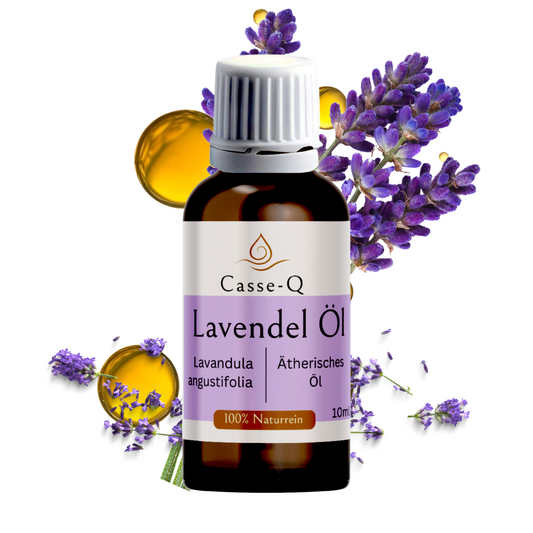
All three may be sold as “lavender oil”. If a bottle says nothing but “lavender”, lavandin is the most likely candidate – it costs a fraction to produce. Our lavender oil is Lavandula angustifolia, and the name is on every label.
Where good lavender oil comes from
The classic origins are France and Bulgaria, alongside growing areas in Eastern Europe. What matters is less the country than the altitude: higher up, true lavender forms less camphor and more of the soft, floral components. That is why mountain lavender smells rounder than lowland lavender.
What lavender oil smells like
The typical impression is floral with a lightly herbal, almost hay-like base. Lavender is a heart note: it takes a few minutes to unfold fully, but then carries for several hours. Freshly distilled oil often seems a little sharper and rounds off over the first months.
Use and dosage
- Diffuser: 3 to 5 drops in 150 to 200 ml of water. Lavender goes a long way; more quickly becomes too much.
- Scented pillow: one drop on a cloth, not directly on the pillowcase – essential oils can leave marks.
- Bath: never neat into the water. Emulsify first in cream, honey or a carrier oil, then add.
- DIY cosmetics: the usual dilution is 1 to 2%, meaning roughly 10 to 20 drops per 50 ml of carrier oil.
- Sauna: diluted into the infusion water, never neat onto the stones.
What lavender combines well with
Lavender is one of the most agreeable blending partners there is. Proven combinations:
- with lemon and orange for a bright, soft room note – ready-blended as Sonnenruhe
- with cedarwood or Swiss stone pine for a calm, woody direction
- with peppermint for a clear, fresh contrast
Shelf life
Stored cool, dark and tightly closed, lavender oil stays stable for around three to four years – longer than citrus oils, shorter than wood oils. If the scent turns sharp and volatile or reminds you of varnish, the oil has taken up oxygen.
Frequently asked questions
Is lavandin worse than true lavender?
Not worse, but different. Lavandin smells fresher and sharper and works well in cleaning blends and room sprays. For a soft, floral note, true lavender is the right choice. The only real problem is lavandin being sold as true lavender.
Why does my lavender oil smell different from last time?
Because it is a natural product. Harvest year, weather and altitude shift the scent profile slightly. Larger deviations can be traced through the batch number.
Can I apply lavender oil neat to the skin?
We do not recommend it. Essential oils belong on the skin diluted, even the gentle ones.
How many drops are in a millilitre?
Depending on viscosity, about 20 to 30. So 10 ml gives you roughly 200 to 300 drops – enough for many weeks of diffuser use.
More on the origin, quality and prices of over 70 oils is in our book “The Truth About Essential Oils”.